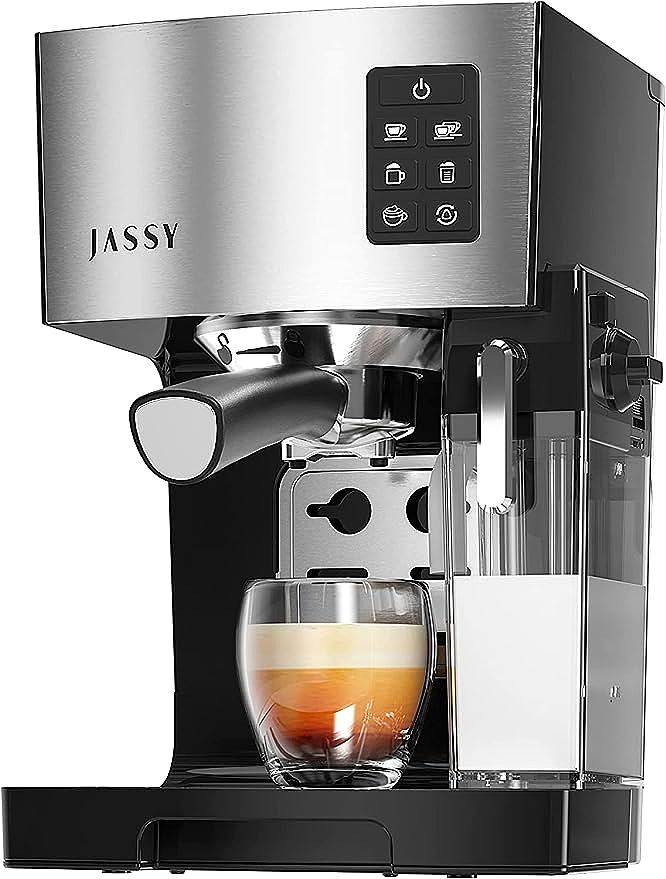
It sits on a kitchen counter, a compact monument of plastic and stainless steel. In the quiet hum of a waking home, a button is pressed. A series of whirs and hisses ensues, and a dark, fragrant liquid streams into a cup, crowned with a fleeting layer of crema. It feels like a small, daily miracle. But within the shell of a machine like the JASSY JS-100 lies a story—not of magic, but of brilliant engineering, calculated science, and a series of fascinating compromises.
To understand this story, we must place this machine, a typical specimen of its class, on our proverbial operating table. Our goal is not to praise or condemn it, but to use it as a window. By dissecting its design choices, we can peer into the soul of nearly every consumer appliance. For every machine, from the simplest to the most extravagant, is a physical manuscript of trade-offs. Learning to read that manuscript makes us not only smarter consumers, but better brewers.

The Pressure Paradox: Engineering for Imperfection
The first specification that leaps from the feature list is a bold number: 20 BARs of pressure. In a marketplace where “more” is ubiquitously marketed as “better,” this figure sounds like a declaration of immense power. But in the nuanced world of espresso, is more force truly superior?
The story of espresso pressure is a tale of post-war Italian innovation. Before the 1940s, espresso was a steam-driven, often scorched affair. It was Achille Gaggia who, by replacing steam with a manually operated piston, first achieved the high pressure required to emulsify coffee oils into the velvety foam we now call crema. Decades later, innovators at Faema electrified the process, and through extensive research, the industry standardized the ideal extraction pressure at a much lower figure: approximately 9 BARs. This isn’t an arbitrary number. As confirmed by decades of research, such as that foundational to the SCAA’s “Coffee Brewing Handbook,” 9 BARs is the scientifically determined sweet spot. It is a pressure high enough to extract desirable soluble compounds from finely ground coffee in a 25-30 second window, yet gentle enough to avoid obliterating the delicate coffee puck.
So, what is the purpose of 20 BARs? It’s less about optimal extraction and more about a brute-force compensation strategy. The 9-BAR standard assumes a near-perfect coffee puck—uniformly ground by a high-quality burr grinder and expertly tamped. In a home environment, using pre-ground coffee or an inconsistent blade grinder, the puck is often flawed, riddled with invisible fractures and areas of uneven density. A higher pressure, like that advertised on the JASSY, can blast through these imperfections to ensure water passes through, acting as an engineering failsafe against a completely stalled shot.
The danger, however, is a phenomenon baristas know intimately: channeling. Imagine the coffee puck as a dam and the water as the reservoir. At 9 BARs, the water percolates through the dam’s structure evenly. At 20 BARs, the immense force can exploit the tiniest crack, a microscopic fissure, and carve a high-velocity channel directly through the coffee. This is a catastrophic breach. The water bypasses most of the coffee grounds, resulting in a shot that is tragically paradoxical: simultaneously sour (from the under-extracted bulk of the puck) and bitter (from the over-extracted grounds lining the channel). The impressive number, then, reveals our first great compromise: sacrificing the potential for perfection for a higher probability of simple function.
The Barista’s Response: You cannot change the machine’s pump, but you can improve what it acts upon. Focus on puck preparation. Even with a basic grinder, distribute the grounds evenly in the portafilter before tamping. Tamp level and with consistent pressure. You are creating a more robust “dam” to better withstand the machine’s aggressive pressure.

The Thermal Dilemma: A Race Between Speed and Stability
If pressure is the forceful hand of espresso, temperature is its sensitive soul. The cascade of chemical reactions that unlocks coffee’s hundreds of aromatic and flavor compounds is fiercely dependent on a stable temperature, ideally hovering within the golden range of 90-96°C (195-205°F). It is here we encounter one of the most common complaints about entry-level machines, echoed in a user review of our specimen: the coffee is merely lukewarm.
The culprit lies in the heart of the machine’s heating system. Powered by a respectable 1250 watts, a machine in this class almost certainly employs a thermoblock heater. Think of it as an on-demand water heater for your coffee. A small block of metal, typically aluminum, has a long, coiled channel running through it. As cold water is pumped in from the reservoir, the block rapidly heats it on its journey to the coffee puck. This design is fast, compact, and energy-efficient—a perfect trifecta for a mass-market consumer appliance.
The alternative, found in more expensive “prosumer” machines, is a boiler. A boiler is like a traditional home water heater—a heavy, insulated tank (often brass or copper) that keeps a significant volume of water constantly at the target temperature. Its large thermal mass means that when you initiate a shot, the temperature remains rock-solid. The thermoblock, with its low thermal mass, is a sprinter; the boiler is a marathon runner. While the thermoblock can heat the initial slug of water quickly, the continuous influx of cool water can overwhelm it, causing the temperature to sag mid-extraction. This drop is what leads to a sour, underdeveloped, and “lukewarm” flavor profile. This is the second great compromise: in the eternal engineering battle between efficiency and stability, the choice was made for speed and cost, sacrificing the unwavering thermal foundation upon which an exceptional shot of espresso is built.
The Barista’s Response: Fight back against temperature loss. Before you brew, run a “blank” shot of hot water through the machine (without the portafilter) and into your cup. This preheats the thermoblock, the group head, and your vessel, creating a much more stable thermal environment for your actual coffee.

The Alchemy of Automation: Trading Control for Convenience
Having navigated the turbulent worlds of pressure and temperature to create our espresso shot, we arrive at the final act for many: the addition of milk. A machine like the JASSY promises a perfect cappuccino at the press of a button—an act of apparent magic. But this magic, too, has a price, paid not in dollars, but in control.
The process is a beautiful dance of physics and chemistry. The physics is driven by the Venturi effect. High-pressure steam is blasted through a narrow nozzle inside the frothing unit. This creates a low-pressure zone that simultaneously siphons milk up from the attached container and draws in a tiny amount of air. This mixture of steam, milk, and air is then violently agitated in a chamber, creating the foam.
The chemistry happens within that turbulence. Milk is a complex suspension of fats, sugars, and two key proteins: casein and whey. When heated to around 65°C (150°F), the delicate whey proteins unfurl, or “denature.” These unfolded proteins are excellent emulsifiers; they immediately wrap themselves around the air bubbles being injected, creating a strong, stable, and fine-textured microfoam. The fat globules contribute a rich mouthfeel, but too much fat can inhibit a stable foam structure.
The machine’s one-touch system executes this beautifully, but reveals our next compromise: the lack of control. A barista with a manual steam wand is an artist, precisely controlling the amount of air introduced (stretching) and the final temperature (steaming) to create textures ranging from the stiff, airy foam of a traditional cappuccino to the silky, paint-like microfoam of a flat white. The automated system, for all its convenience, produces one texture and, as users note, a non-adjustable volume. It’s the trade-off between an artist’s palette and a paint-by-numbers kit. Both can create a picture, but only one offers true creative freedom.
The Barista’s Response: While you can’t change the texture, you can influence the flavor. Use fresh, cold milk straight from the refrigerator. The colder the milk, the longer the frothing process takes to reach its final temperature, which can result in a slightly sweeter and more stable foam.
The Material Covenant: A Study in Calculated Lifespans
This elegant dance of physics and chemistry, executed flawlessly thousands of times, eventually runs into a far more terrestrial problem: the very materials it is made of. A user’s lament that a milk container “always breaks after 2 months” is not just a complaint; it’s a data point, leading us to the final, and perhaps most profound, compromise in our deconstruction.
The engineers designing that container face a classic trilemma. The material must be (1) food-safe and chemically resistant to milk’s lactic acid and cleaning detergents; (2) durable enough to withstand the daily mechanical stress of being clicked into place and the thermal shock of heating and cooling; and (3) inexpensive enough to meet a target retail price. Plastics like ABS are cheap and strong but can become brittle with repeated thermal cycles. Polypropylene (PP) offers better chemical resistance but might feel less premium. High-performance plastics like Tritan are fantastic but would significantly drive up the unit cost.
The repeated failure at a specific timeframe suggests a design living at the edge of its fatigue limit. Every time the container is handled, every time it’s washed, microscopic stresses accumulate within the polymer structure. It’s a silent, invisible war being waged at the molecular level. This is perhaps the most fundamental compromise of all: the covenant between the consumer and the product is not for a lifetime, but for a calculated, commercially viable lifespan. The machine is designed not to last forever, but to function for just long enough to be perceived as providing value for its price.
The Barista’s Response: Treat the machine’s plastic components with mechanical sympathy. When cleaning, use gentle detergents and avoid abrasive sponges. When inserting or removing parts, do so without excessive force. You are extending the component’s life by reducing the accumulation of micro-stresses.
To Brew with Understanding
As we step back from our metaphorical operating table, the JASSY JS-100 no longer looks like a simple appliance. It is a physical manifestation of engineering decisions. Its high pressure speaks of a design that values function over finesse. Its heating system tells a story of efficiency triumphing over stability. Its automated frother is a monument to convenience over control, and its fragile components whisper a tale of cost versus longevity.
This is not a story unique to one machine. It is the story of nearly every tool in our modern lives. To understand this is to be empowered. When you know that your machine’s temperature is its likely weakness, you learn to run a blank shot to preheat everything. When you grasp the brute-force nature of its pressure, you focus on meticulous puck preparation.
The magic of that morning coffee doesn’t disappear with this knowledge. It transforms. It is no longer the passive magic of an opaque black box, but the active, engaged magic of a partnership. The real artistry of the home barista is not found in owning the perfect, uncompromising machine, but in deeply understanding the soul of the machine you have—compromises and all—and learning how to dance with it to create a moment of beauty in a cup.