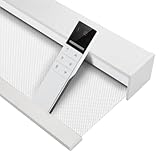
A window is essentially a hole in your home’s thermal envelope. In summer, it is a solar radiator; in winter, it is a heat sink. The TIPIACE ZM25-EAZ is not just a privacy screen; when properly deployed, it acts as a secondary insulation barrier. This capability is derived strictly from the material science of its 82006 Full Blackout Series fabric and the geometry of its installation.
Deconstructing the 663g/m² Barrier
The specification sheet lists the fabric weight at 663g/m² (grams per square meter) with a thickness of 0.84mm. In the textile industry, these numbers indicate a heavy-duty, multi-layered composite (Data). Unlike standard curtains which rely on dye to absorb light, this fabric likely employs a core layer (often fiberglass or tightly woven polyester) sandwiched between PVC or acrylic coatings.
This density serves two distinct physical functions. First, it achieves 100% Opacity. Photons hitting the exterior surface are either reflected (if white-backed) or absorbed, but none transmit through the matrix. This is critical for circadian rhythm management in bedrooms. Second, and more importantly for energy bills, is the Thermal Resistance (R-value). The 0.84mm thickness provides a physical mass that slows conductive heat transfer (Physics). When the blind is lowered, it creates a “dead air space” between the fabric and the glass. Air is an excellent insulator if it is stagnant. By trapping this air layer, the system significantly reduces the U-factor of the window assembly (Thesis).
However, this thermal shield has a potential downside known as thermal stress. If a dark-colored blackout blind is placed too close to a non-tempered double-pane window in direct sunlight, the heat absorbed by the fabric can reflect back onto the glass, causing the inner pane to heat up rapidly while the outer pane remains cool. This differential expansion can, in rare extreme cases, lead to glass thermal fracture (FMEA). Users with older windows should opt for lighter-colored fabrics to reflect solar gain rather than absorb it (Nuance).

The Geometry of Light Leakage: The “Halo Effect”
You can have a fabric that blocks 100% of light, but if the installation is flawed, you will still wake up at dawn. This is the Light Gap Paradox. Roller shades, by design, have hardware brackets at both ends. The fabric width is always narrower than the total bracket width—typically by about 1/2 to 1 inch total.
In an Inside Mount scenario (where the blind sits inside the window frame), this mechanical deduction creates a visible “halo” of light on the sides (Scenario). TIPIACE’s customized manufacturing allows for precision sizing (down to the 1/8th inch), but they cannot change the laws of physics regarding bracket clearance. The only engineering solution for total darkness is an Outside Mount, where the blind overlaps the window frame by at least 2-4 inches on all sides, physically sealing the light path.
TIPIACE attempts to mitigate this with their “Made-to-order” precision. A generic “cut-to-size” blind from a big-box store might leave a 1.5-inch gap because it moves in 1-inch increments. TIPIACE’s custom process minimizes this gap to the absolute mechanical minimum required for rotation (Nuance). But users must understand: inside mounting a roller shade will have gaps. It is intrinsic to the mechanism, not a defect of the product.

Durability and Environmental Fatigue
The fabric material is listed as “Water-proof and easily washable.” This suggests a hydrophobic coating, likely PVC-based. In high-humidity environments like bathrooms or kitchens, natural fibers (cotton/linen) act as sponges, promoting mold growth. The synthetic nature of the 82006 series makes it impervious to hygroscopic expansion (Physics).
However, polymers react to UV radiation. Over 5-10 years of exposure to direct sunlight, the plasticizers in the coating may migrate, leading to stiffening or brittleness at the edges. While the aluminum bottom rail provides weight to keep the fabric flat, a curled edge is the classic sign of UV-induced material fatigue in roller shades (Challenge). Regular cleaning with a damp cloth can remove surface dust, but it cannot reverse UV degradation.
Conclusion: A Shield, Not Just a Curtain
The TIPIACE ZM25-EAZ utilizes high-density engineering materials to manage the flux of energy—both light and heat—into the home. By understanding the interplay between fabric density, air gaps, and mounting geometry, users can transform a simple window covering into an effective component of their home’s thermal management system.

