
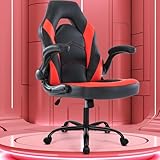
We spend a lot of time analyzing the ergonomics of sitting in a chair. But for many of us in apartments, dorms, or multi-use home offices, there’s an even bigger problem: the ergonomics of the chair when you’re not in it.
A typical office or gaming chair is a space-hogging obstacle. It’s a 26-inch wide, 30-pound piece of furniture that, thanks to its fixed armrests, can’t be pushed under the desk. It lives permanently in your walking path, visually shrinking your room and becoming a constant, low-level annoyance.
This is the tyranny of the fixed armrest.
The “Stowable” Solution: Deconstructing Flip-Up Arms
The solution is simple, yet surprisingly uncommon: the flip-up armrest. This design is a game-changer for anyone who doesn’t have a dedicated, 300-square-foot executive office.
The value proposition is twofold.
1. Spatial Ergonomics: Reclaiming Your Room
The primary benefit, as the NEWBULIG C-3895 (ASIN B0CLV6YWD2) description notes, is the ability to “push the leather office chair completely under the desk to maximize space.”
This is not a minor feature. It’s “spatial ergonomics.” It means that for the 16 hours a day you aren’t working, your chair can “disappear,” giving you back 4-6 square feet of perceived and actual floor space. In a small room, this is the difference between “cramped” and “cozy.”
2. Positional Freedom: How You Use the Chair
The second benefit is about how you get into the chair. As one Vine Voice reviewer (Sabrina) of the C-3895 pointed out, “the fact that the armrests move up and down… makes it easier for me to get in and out of the chair.”
This also applies to how you sit. Fixed armrests are restrictive. Flip-up arms allow you to sit cross-legged, play a guitar, or simply move around without being boxed in.

Case Study: The NEWBULIG C-3895
This ~$80 chair is a perfect case study. It’s a “budget” chair, but it prioritizes this high-utility feature. While a more expensive chair might offer 4D-adjustable arms, those arms still won’t get out of the way. The simple, 90-degree hinge on a chair like this is arguably more functional for a small space.
It’s a simple, robust mechanism. While any moving part on a budget chair is a potential point of failure, a simple hinge is far more reliable than a complex, multi-direction adjustment mechanism at the same price point.

Conclusion: “Stowable” is the New “Ergonomic”
If you’re shopping for a chair for a small space, your priorities need to shift. A 180-degree recline is useless if the chair takes over your room.
The “flip-up armrest” is the single most valuable feature for “spatial ergonomics.” It’s a sign that the designers understood that a chair’s “off-duty” behavior is just as important as its “on-duty” comfort. For dorm rooms, apartments, and multi-use living areas, “stowable” is the new “ergonomic.”

