
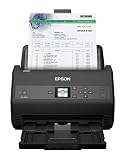
A scanned document, in its rawest form, is dumb. It is a collection of millions of colored dots (pixels) with no semantic meaning. To a computer, a scanned invoice is no different from a photograph of a sunset—it’s just a bitmap. The transformation of this “dumb” image into “smart” data is not a mechanical process; it is a computational one.
While the Epson Workforce ES-865 is a marvel of mechanical velocity, its true value to an enterprise lies in its software architecture. The hardware moves the paper, but the software moves the information. This article explores the invisible layer of the scanning stack: the algorithms that clean, recognize, and route data. We will dissect the industry-standard TWAIN protocol, the pattern recognition logic of OCR (Optical Character Recognition), and the image enhancement algorithms that salvage readable data from imperfect physical originals.
The Universal Translator: TWAIN Protocol Explained
The ES-865 ships with a TWAIN driver. For most users, this is just an acronym on a spec sheet. In the history of computing, it is one of the most important interoperability standards ever created.
Before TWAIN (established in 1992), every scanner required proprietary software to talk to an application. If you wanted to scan into Photoshop, you needed a specific plugin for your specific scanner model. TWAIN solved this by creating a standardized API (Application Programming Interface) between the hardware (the “Source”) and the software (the “Application”).
The Layered Architecture
- Application Layer: Your ERP system, Photoshop, or Document Management System (DMS). It sends a generic command: “Acquire Image.”
- Source Manager: The TWAIN manager in the operating system intercepts this command and routes it to the correct driver.
- Source (Driver): The Epson driver translates the generic command into specific machine code instructions for the ES-865 (e.g., “Activate Motor A at speed X,” “Turn on LED Array”).
For a business, TWAIN compliance means future-proofing. It ensures that the ES-865 is not a standalone island but a peripheral that can integrate with virtually any imaging software developed in the last 30 years. It is the “USB” of the imaging world—a universal connector for data.

The Brain: Optical Character Recognition (OCR)
The bridge between “Pixel” and “Data” is OCR. The ES-865 includes built-in Nuance OCR technology. This is not magic; it is advanced pattern recognition.
Feature Extraction
Modern OCR does not simply match images to a library of fonts. It uses Feature Extraction (or Topological Feature Analysis).
* The algorithm breaks down a character into its component lines, curves, and loops.
* A vertical line + a loop at the top right = “P”.
* A vertical line + a loop at the bottom right = “b”.
This abstraction allows the software to recognize text regardless of the font face or size.
Contextual Analysis
However, visual recognition is prone to error (e.g., confusing “1” (one), “l” (el), and “I” (eye)). Advanced OCR engines employ Lexical Analysis. They check the recognized character strings against a dictionary.
* If the engine sees “HeIIo”, lexical analysis corrects it to “Hello” because “HeIIo” is not in the dictionary.
* This contextual layer dramatically increases accuracy, turning a 95% accurate raw scan into a 99.9% accurate searchable PDF.
Algorithmic Restoration: Fixing the Physical World
Physical documents are imperfect. They are dog-eared, wrinkled, faded, and often fed into the scanner crookedly. If the digital image retains these flaws, OCR fails and the document looks unprofessional.
The Epson ScanSmart software acts as a real-time restoration studio, applying a pipeline of algorithms to every frame passing through the bus at 130 ipm.
1. De-Skew (Geometric Correction)
Even with precise rollers, paper can twist slightly as it travels at high speed. A skew of just 2 degrees can ruin OCR accuracy.
* The Algorithm: The software detects the edges of the paper or the lines of text. It calculates the angle of deviation (\theta) and applies a geometric rotation matrix to the entire image to align it perfectly to the vertical and horizontal axes.
2. Dropout Color (Spectral Filtering)
Forms often use red or green boxes to guide handwriting. These boxes can confuse OCR.
* The Algorithm: Because the scanner captures full RGB color, the software can digitally subtract specific color channels. By “dropping out” the Red channel, a form printed in red ink disappears, leaving only the black handwritten or typed text. This significantly cleans up the data for extraction.
3. Hole Fill (Content-Aware Fill)
Punched holes appear as black dots in a scan.
* The Algorithm: The software identifies circular black patterns near the margins of the page. It replaces these black pixels with the background color (usually white), effectively “repairing” the digital paper.

The Cloud Bridge: Integration Logic
The final step in the software architecture is Routing. A scanned file sitting on a desktop is useless; it needs to be where the work happens.
Modern scanning software, including Epson’s, integrates with cloud APIs (Application Programming Interfaces).
* Direct-to-Cloud: The software authenticates with services like Dropbox, Google Drive, or Evernote using OAuth tokens.
* Metadata Tagging: Advanced workflows allow the user to input metadata (e.g., “Invoice Number,” “Date”) at the time of scanning. This metadata is attached to the file, allowing cloud storage systems to automatically index and sort the document.
This capability transforms the scanner from a passive input device into an active network node. It allows a physical document to be scanned in New York and instantly accessible to a team in London, fully indexed and searchable.
Conclusion: The Invisible Infrastructure
We often obsess over the hardware specs—the horsepower of the motor, the resolution of the sensor. But in the world of document scanning, hardware is just the delivery mechanism. The true product is the data.
The software architecture of the Epson Workforce ES-865—from the foundational TWAIN protocol to the cognitive layers of OCR and the restorative algorithms of image processing—is what gives that data value. It turns a chaotic stream of pixels into structured, orderly, and actionable information. It is the invisible infrastructure that powers the digital efficiency of the modern enterprise.

