
If the amplifier is the muscle of a sound system, the Equalizer (EQ) and Digital Signal Processor (DSP) are the soul. They determine not how loud the sound is, but what it sounds like. They are the tools used to correct the flaws of a room, enhance the timbre of an instrument, and place a dry vocal into a lush, virtual concert hall.
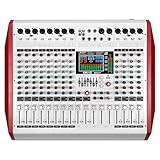
The Kmise 12-Channel Audio Mixer provides two distinct layers of spectral control: a 3-Band Channel EQ for individual instruments and a 7-Band Graphic EQ (GEQ) for the master output. Coupled with a 99-preset DSP engine, it offers a comprehensive toolkit for sonic sculpting.
This article delves into the physics of these controls. We will explore the frequency spectrum, the difference between “musical” and “corrective” EQ, and the algorithms that simulate acoustic space.
The Frequency Spectrum: Mapping the Sound
Human hearing spans from 20 Hz to 20,000 Hz (20 kHz). Audio engineering divides this continuous spectrum into bands that correspond to musical characteristics.
* Low (20Hz – 250Hz): The foundation. Kick drums, bass guitars. Power and weight.
* Mid (250Hz – 4kHz): The body. Vocals, guitars, keys. Intelligibility and presence.
* High (4kHz – 20kHz): The detail. Cymbals, vocal breath, air. Clarity and definition.
The 3-Band Channel EQ: Musical Shaping
Each channel on the Kmise mixer has knobs for Low, Mid, and High. These are likely Shelving (Low/High) and Peaking (Mid) filters.
* Physics of the Shelf: The Low and High knobs act like a ramp. Boosting the Highs doesn’t just boost one frequency; it boosts everything above a certain point (e.g., 12kHz). This is broad, musical shaping used to make a source “brighter” or “warmer.”
* Physics of the Peak: The Mid knob boosts a bell-shaped curve around a center frequency (e.g., 2.5kHz). This is critical for cutting through a mix. Boosting 2.5kHz helps a vocal stand out; cutting 500Hz removes “mud.”
The 7-Band Graphic EQ: Corrective Surgery
The Master section features a 7-slider Graphic EQ. Unlike the broad strokes of the channel EQ, this is a surgical tool designed for the room.
* Room Modes: Every room has resonant frequencies where bass builds up (standing waves) or trebles reflect harshly.
* Feedback Suppression: In live sound, microphone feedback happens at specific frequencies. The GEQ allows the engineer to “notch out” (cut) the specific frequency band where feedback is occurring, allowing for higher volume before squealing.
* System Tuning: PA speakers are rarely perfectly flat. The GEQ allows the user to flatten the system’s response, compensating for a speaker that might be naturally too bass-heavy or shrill.
DSP: The Mathematics of Space
The Kmise mixer boasts 99 DSP Effects. DSP stands for Digital Signal Processing. It involves converting the audio into numbers and applying mathematical algorithms to simulate physical phenomena.
Reverb (Reverberation)
Reverb is the sound of a room. When you clap your hands in a cathedral, you hear thousands of reflections bouncing off the walls, floor, and ceiling, decaying over time.
* The Algorithm: The DSP chip calculates these reflections. It simulates the Pre-delay (time until the first reflection hits), the Decay Time (RT60) (how long until the sound dies out), and the Damping (how surface materials absorb high frequencies).
* Usage: Adding reverb to a “dry” vocal (recorded close to the mic) pushes it back into a virtual space, making it blend with the instruments and sound more natural and emotional.
Delay (Echo)
Delay is a distinct repetition of the sound.
* The Physics: It simulates a sound wave traveling a long distance, hitting a canyon wall, and returning.
* Creative Use: Short delays (Slapback) thicken vocals. Long, rhythmic delays create atmospheric textures.
The Aux Send: Routing to the FX Engine
How does the signal get to the DSP? Through the Auxiliary (EFX) Send.
Each channel has an “FX” knob. This controls how much of that channel’s signal is diverted to the effects processor. This architecture allows for a “Wet/Dry” mix.
* Parallel Processing: The original “Dry” signal goes straight to the main speakers (keeping it clear and punchy). The “Wet” signal goes to the DSP, gets reverberated, and is then added back into the mix. This ensures that the clarity of the vocal is never lost in the wash of the effect.

Conclusion: The Engineer as Artist
The Kmise 12-Channel Audio Mixer places the power of physics at the user’s fingertips. The EQ knobs manipulate the energy distribution of the frequency spectrum. The DSP engine manipulates the time domain to create artificial spaces.
By understanding the science behind these controls—knowing why to cut 500Hz or when to use a Hall Reverb—the user stops randomly turning knobs and starts sculpting sound with intention. This is the transition from audio operator to audio engineer.

