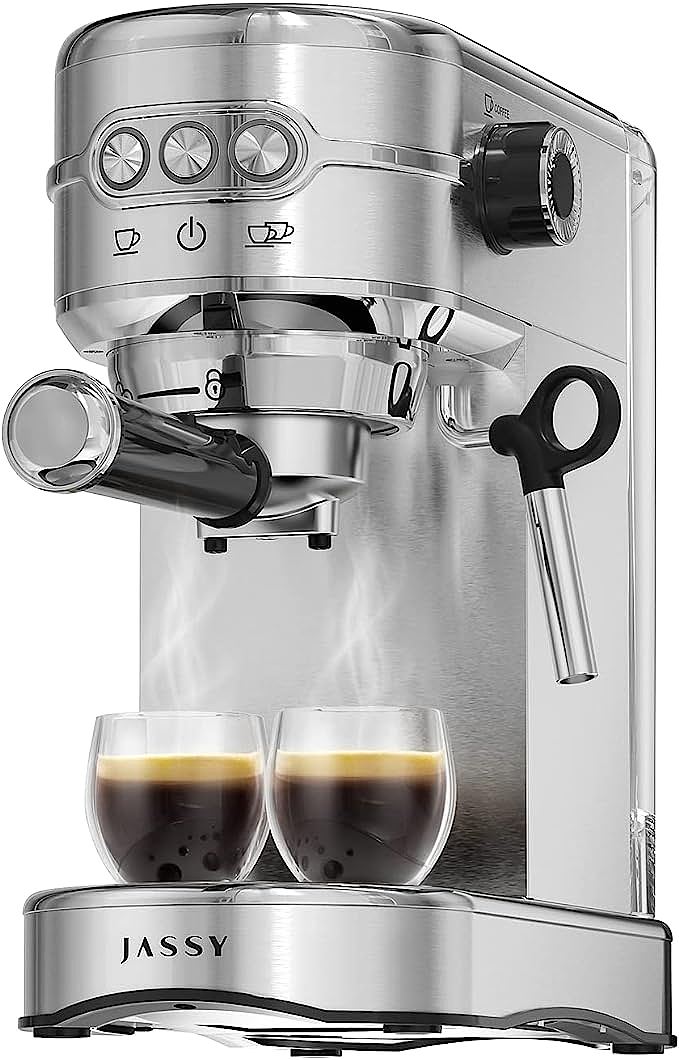
Espresso is a dance of temperature. The difference between a sweet, balanced shot and a bitter, astringent one can be a matter of just a few degrees. Furthermore, the transformation of milk into silky microfoam requires a sudden, massive injection of thermal energy. For a compact, single-boiler (or single-thermoblock) machine like the JASSY JS-105, managing these fluctuating thermal demands is the ultimate engineering challenge.
The user reviews for this category of appliance often mention issues like “watery steam” or “temperature inconsistency.” These are not random glitches; they are symptoms of the underlying Thermodynamics. Understanding how these machines generate and manage heat—and the limitations of that process—is key to mastering them. This article explores the science of Thermoblocks, the physics of steam generation, and the thermal properties of the machine’s materials.
The Engine of Heat: Thermoblock vs. Boiler
Traditional commercial machines use large boilers holding liters of water. These boilers act as massive thermal batteries, providing incredible temperature stability but requiring long warm-up times (30+ minutes).
Home machines like the JASSY JS-105 typically use a Thermoblock or Thermocoil.
* The Mechanism: A Thermoblock is a block of metal (usually aluminum or steel) with a labyrinth of water pipes carved inside. Powerful heating elements (1450W in this case) heat the metal block. As water is pumped through the labyrinth, it “flash heats” on contact with the hot metal.
* The Advantage: Speed. The machine is ready to brew in seconds, not minutes. It is energy-efficient, heating only the water needed for the shot.
* The Challenge: Consistency. The water temperature depends on the flow rate. If the water flows too fast, it may not reach the target temperature. If it flows too slow, it may overheat. Modern controllers (PID) help, but the physics of “flash heating” is inherently less stable than a boiler.
This explains the “1450W” specification. High wattage is crucial not for maintaining heat, but for recovery. When cold water enters the block, the temperature drops. A high-wattage element can pump energy back into the block rapidly to minimize this drop during the extraction.
The Steam Dilemma: Phase Change Energy
Creating steam requires significantly more energy than creating hot water. To boil water (100^\circ C) from room temperature requires sensible heat. But to turn that boiling water into steam requires Latent Heat of Vaporization—a massive energy jump.
In a single-thermoblock machine, the user must switch from “Coffee Mode” (approx 93^\circ C) to “Steam Mode” (approx 130^\circ C+).
1. The Ramp Up: The thermoblock must heat up rapidly to generate steam. This takes time (and water purging).
2. The Purge: When the valve is first opened, the water remaining in the lines (which is liquid) is ejected before the steam (gas) can follow. This explains why users often see “jets of hot water” initially—it is condensed steam and residual water clearing the path.
3. The Cool Down: After steaming, the block is superheated (130^\circ C). If you try to brew espresso immediately, the water will flash-boil, scorching the coffee. The machine (or the user) must flush water through the system to cool the block back down to brewing temperature (93^\circ C).
This thermal hysteresis (lag) is the defining characteristic of single-heating-element machines. The “Powerful Milk Foaming” claimed by the JASSY JS-105 relies on the user understanding this cycle: wait for the heat to build for steam, and purge the heat before returning to coffee.
Material Science: The Role of Stainless Steel
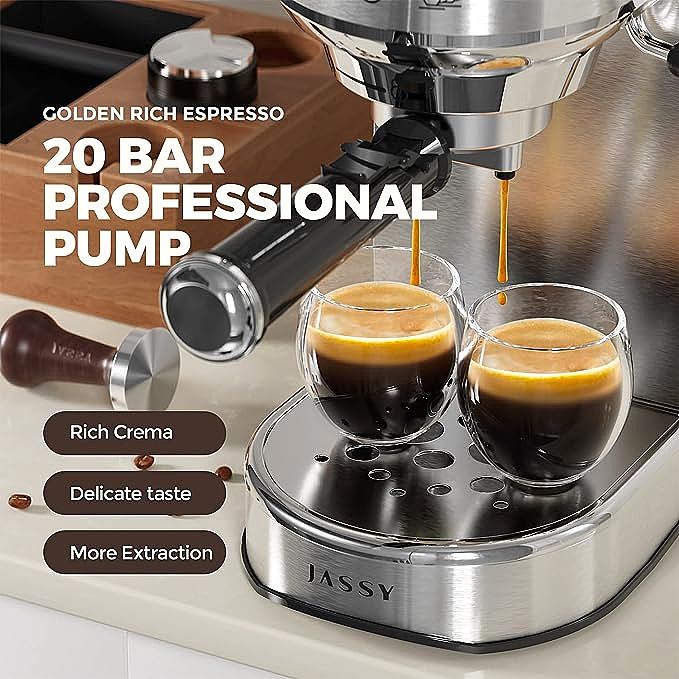
The JASSY JS-105 emphasizes its “304 Stainless Steel Body.” In the context of thermodynamics, materials matter.
* Thermal Mass: While the external body doesn’t directly heat the water, a metal chassis absorbs and radiates heat. Once the machine is fully warmed up, the metal body helps create a stable thermal environment, reducing heat loss from the internal components to the outside air.
* The Cup Warmer: The top of the machine gets warm due to waste heat rising from the thermoblock. This is a functional feature. Espresso brewed into a cold ceramic cup loses temperature instantly (approx 10^\circ C drop). Pre-heating the cup on the stainless steel warmer (or with hot water) preserves the volatile aromatic compounds that are temperature-sensitive.
* Hygiene and Corrosion: 304 Stainless Steel is an austenitic steel containing chromium and nickel. It is chemically inert and highly resistant to the acidic nature of coffee oils and the scaling potential of water. This ensures that the flavor of the espresso is not tainted by metallic leaching over time.
The Physics of Foam: Steam Velocity and Vortex
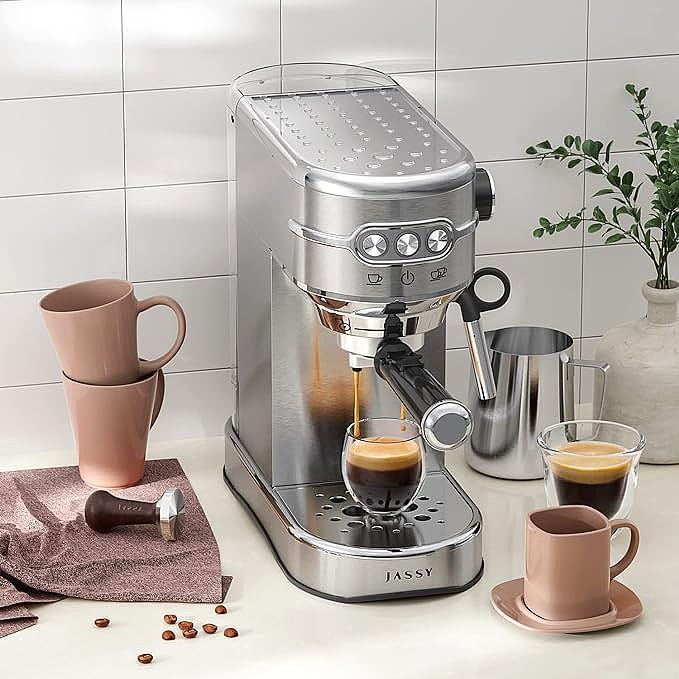
The goal of the steam wand is to create Microfoam. This involves two physical processes: Air Entrainment (Stretching) and Turbulence (Rolling).
* Velocity: The steam must exit the wand at high velocity. This velocity creates a shear force that rips the air into microscopic bubbles. High pressure (temperature) in the thermoblock is required to generate this velocity.
* Vortex: The steam jet must have enough momentum to spin the milk in the pitcher. This rolling motion folds the bubbles into the liquid, creating a uniform, velvety texture.
If the thermoblock cannot maintain temperature (and thus pressure), the steam velocity drops. The bubbles become large and soapy, and the milk doesn’t roll. The JASSY’s 1450W power is, therefore, directly correlated to its ability to sustain the steam velocity needed for cappuccino-quality foam.
Conclusion: Mastering the Thermal Cycle
The JASSY JS-105 is a machine governed by the laws of thermodynamics. Its performance is not static; it fluctuates with temperature. For the home barista, “Operating” the machine is really about “Managing” this thermal energy. It involves pre-heating the group head, purging the steam wand, and temperature surfing between modes.
While it lacks the massive thermal stability of a commercial dual-boiler, its agility (fast heat-up) and power density (1450W) make it a capable tool for those who understand its rhythm. By respecting the physics of heat transfer and phase change, one can extract the full potential of the bean and the milk, proving that great espresso is as much a triumph of science as it is of art.