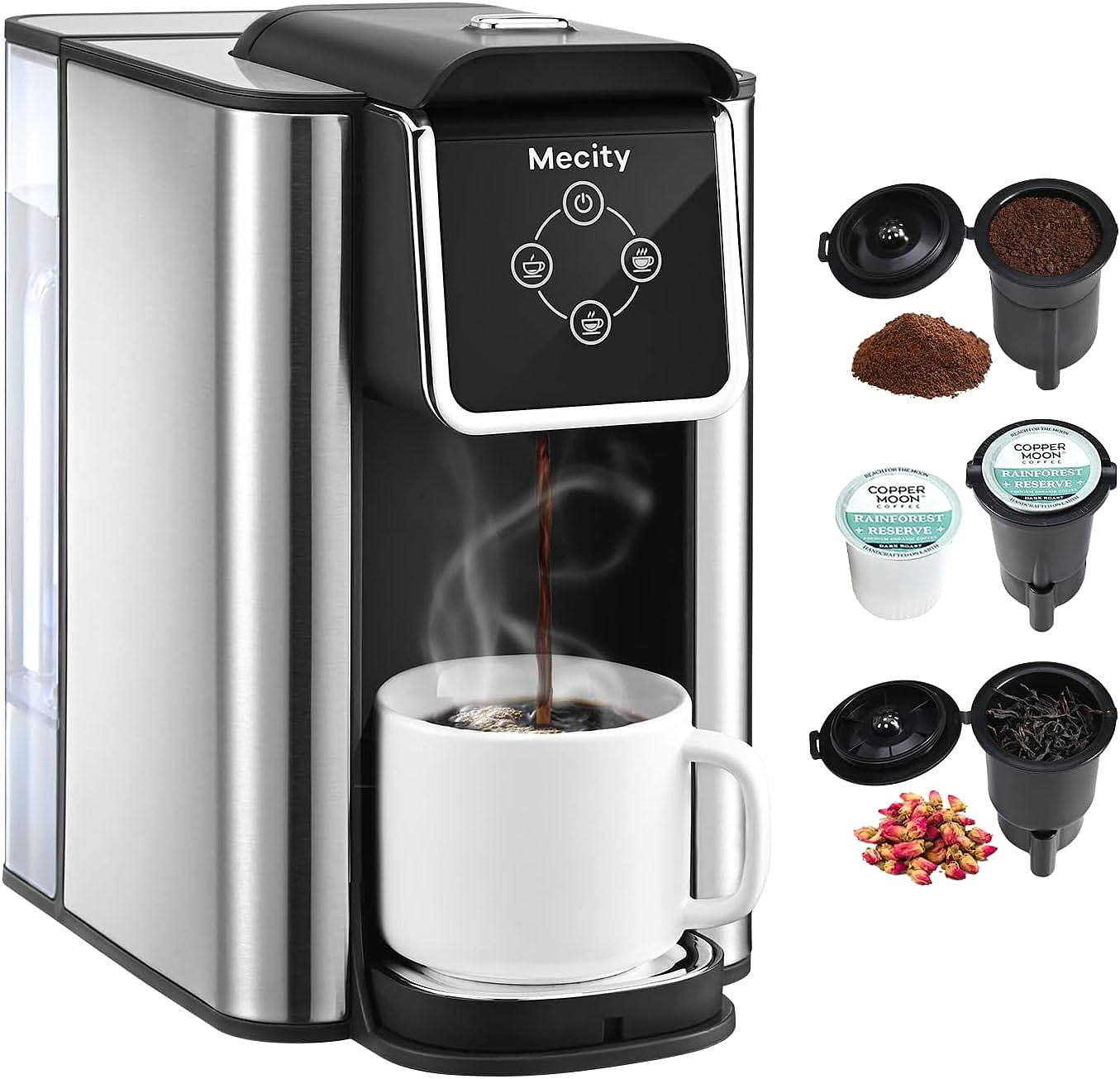
The modern morning is a race against time. In this context, the coffee machine has evolved from a slow, gurgling pot to a high-velocity extraction engine. Devices like the Mecity KC101 promise a hot cup in under two minutes. This feat is not magic; it is a triumph of Thermodynamics and Fluid Control.
To understand how cold water is transformed into hot coffee in 60 seconds, we must look beyond the plastic shell and examine the energy transfer mechanisms within. How does 1150 watts of power translate into water temperature stability? What is the relationship between flow rate and extraction quality? This article dissects the engineering of rapid brewing, exploring the physics that powers our daily caffeine ritual.
The Energy Equation: 1150 Watts of Heat
The core specification of the KC101 is its 1150W Power Rating. In physics, power (P) is the rate at which energy (E) is transferred: P = E/t.
To heat water from room temperature (20^{\circ}C) to brewing temperature (92^{\circ}C), a specific amount of energy is required, governed by the specific heat capacity of water (4.18 J/g^{\circ}C).
- The Challenge: Traditional drip coffee makers use a simple aluminum tube heater. They heat water slowly, relying on the expansion of steam bubbles to push water up (the “gurgle” effect). This is slow and temperature-unstable.
- The Solution: Rapid brewers like the KC101 typically employ a Flash Heating Element or a specialized Thermocoil. With 1150 watts available, the system can pump energy into the water stream almost instantly.
- Calculation: To heat 8oz (236ml) of water by 72^{\circ}C takes approximately 71,000 Joules. At 1150 Watts (Joules/second), the theoretical minimum heating time is about 62 seconds (assuming 100% efficiency).
- Reality: The KC101’s “60 to 100 seconds” spec aligns perfectly with this thermodynamic limit. It indicates a system operating near the peak of resistive heating efficiency.
This high power density ensures that water hits the coffee grounds at the correct temperature immediately, avoiding the “sour start” of colder water that plagues slower machines.

Fluid Dynamics: The “Smart Flow” System
Heating water is only half the battle; moving it is the other. The description mentions a “Smart Flow Management System.” In engineering terms, this likely refers to a Pulse-Width Modulated (PWM) Pump.
Unlike gravity-fed drip machines, single-serve brewers use a pump to force water through the heater and into the pod.
* Flow Rate vs. Temperature: There is an inverse relationship. Faster flow means less time in the heater (cooler water). Slower flow means more heat absorption (hotter water).
* The Control Loop: A smart flow system dynamically adjusts the pump speed. If the thermistor detects the water is too cool, the pump slows down to let it heat up. This ensures that the first drop and the last drop are within the optimal extraction window (90-96^{\circ}C).
This active flow control is what allows the machine to offer “precise brewing” across different cup sizes (6, 8, 10 oz). Whether brewing a small concentrated shot or a large mug, the thermodynamics are balanced by adjusting the flow duration and velocity.
Extraction Kinetics: K-Cup vs. Gravity
The KC101 is a hybrid. It must handle Pressurized Extraction (K-cups) and Gravity Filtration (Grounds/Tea).
* K-Cup Physics: A K-cup is a mini pressure vessel. The machine’s needle pierces the lid, injecting hot water. The internal pressure builds until it forces through the bottom filter. This creates Turbulence inside the pod, ensuring total saturation of the grounds in a very short time. The “sharp spine” mentioned in the filter pod description is the mechanism that facilitates this injection.
* Grounds Physics: When using the reusable filter, the physics shifts to Percolation. Water flows through the loose bed of grounds. Here, the machine’s flow rate must be gentle enough not to channel (drill a hole) through the bed, but fast enough to finish in under 2 minutes.
The machine’s ability to switch between these modes suggests a versatile pump curve—capable of generating the head pressure needed for K-cups while maintaining a steady stream for loose grounds.

Case Study: The Engineering of Compactness
The KC101 is just 6.3 inches wide. Compressing a high-power heater, a pump, control electronics, and a 1.5L tank into this footprint requires vertical integration.
* Thermal Isolation: With 1150W of heat generation, internal components (like the PCB) must be shielded. The vertical stack design likely places the heater at the back or bottom, using the water tank itself as a thermal buffer.
* Fluid Path Optimization: Short tubing runs reduce heat loss and pressure drop. The compact nature forces an efficient layout, which paradoxically improves performance by minimizing the distance water travels from heater to coffee.
Conclusion: The Velocity of Flavor
The Mecity KC101 is a machine built for velocity. It leverages high wattage and active flow management to compress the traditional brewing ritual into a minute-long event.
By understanding the thermodynamics of flash heating and the fluid dynamics of forced extraction, users can appreciate the complexity behind the convenience. It is not just hot water; it is energy management on a countertop scale, delivering the precise thermal payload required to unlock the flavor of the bean in seconds.

