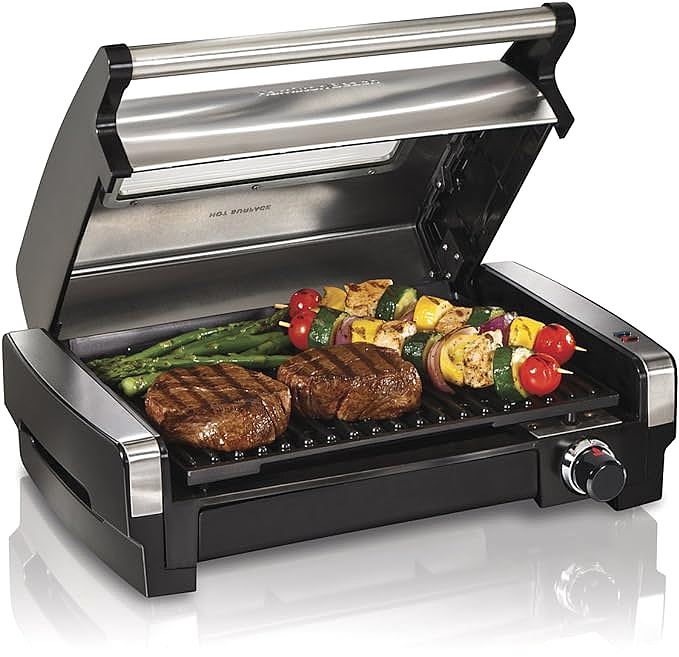

You’ve just unboxed your new indoor searing grill, like the Hamilton Beach 25361. You’re dreaming of those perfect, caramelized grill marks. But your first attempt is… disappointing. Instead of a sizzle, you get a “lots of smoke,” and as user Marion noted, “all that would sear is the part where the grate touches.”
This is a common experience, and it’s not the grill’s fault. It’s a simple misunderstanding of the physics of indoor searing. Here are the pro-tips, sourced from user experiences, to take your results from a 3-star steam to a 5-star sear.
The #1 Misconception: “My Grill is Smoking” (It’s Probably Steaming)
If you put wet, marinated food on a 450°F surface, the “smoke” you see is likely just super-heated steam. As user Marion correctly observed, this happened because her “wet” pork chops were put on the grill.
When the grill’s energy is busy boiling off that surface moisture, it can’t get to the work of searing the meat. You are steaming your food, not grilling it.
The Fix: Pat Your Food Dry.
Before grilling, take your steak or pork chop out of the marinade and pat it completely dry with paper towels. This allows the hot grate (which, on this grill, is the heating element) to make direct contact with the meat, instantly initiating the Maillard reaction (searing) instead of boiling water.
Pro-Tip 2: Understand the “Sear” Function (It Will Cycle)
Many users, like BarbZ, get fantastic results but note that the grill “heated to 450 (but did not stay at that level).” This is not a defect; it’s how it’s designed.
The “Sear” function is a thermostat-controlled peak. It heats the embedded element to 450°F, then the green “preheat” light goes off. When you add cold food, the temperature drops, the thermostat kicks back on, and it reheats. It cycles to maintain this average temperature. Your job is to preheat it fully to 450°F to get that initial, powerful sear.
Pro-Tip 3: Use the Heat Zones (The Center vs. The Sides)
A 5-star user, BarbZ, shared a brilliant professional technique. She wanted to cook a steak and vegetables simultaneously.
She “put a slice of onion and mixed peppers on the grill with the steak.” But to prevent them from burning, she “moved the onion and peppers off the center of the grill to the side panel to keep them warm, but not burned.”
The Fix: Don’t treat the 118 sq. in. surface as one uniform zone. The center, directly over the core of the embedded element, is your “searing” zone. The edges are slightly cooler—a perfect “warming” or “gentle cooking” zone for vegetables, shrimp, or pineapple.

Pro-Tip 4: Oil the Food, Not the Grill
The nonstick plate (rated 4.5/5 for “Easy to clean”) doesn’t need much oil. If you do oil, lightly brush a high-smoke-point oil (like avocado or canola, not extra-virgin olive oil) onto your food just before placing it down. This prevents flare-ups and excess smoke from oil burning in the drip tray.
By understanding that you must control moisture and heat zones, you can unlock the true potential of this device, achieving the “stunning” and “incredibly juicy” results that 5-star users rave about.