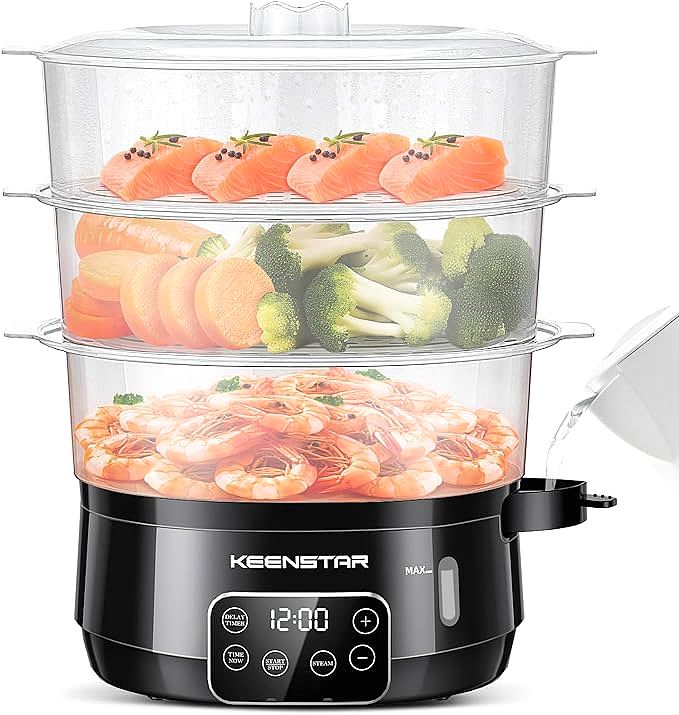

The 3-tier food steamer is a marvel of kitchen efficiency. The promise is seductive: cook your entire meal—protein, grains, and vegetables—all at once. An appliance like the KEENSTAR MK902A, with its “super FAST” 800W engine, seems to make this promise a reality.
Then, you try it. And you discover the “Vertical Kitchen” problem: the food on the bottom tier is overcooked mush, while the food on the top tier is still crunchy.
This is not a product flaw. It is a physics problem. As user “Federica” (a Vine reviewer) astutely noted, “You will need to adjust a bit in terms of timing.”
This is the strategic guide to why you need to adjust, and how to do it perfectly.
The Physics: Why the Top Tier Is Always Slowest
Think of your steamer as a “vertical kitchen.” An 800W “steam accelerator” at the base boils water, sending 212°F (100°C) steam—a highly efficient energy carrier—upward.
1. Bottom Tier: This tier gets the full blast of the hottest, most energetic steam. It cooks the fastest.
2. Middle Tier: To reach this tier, the steam must pass through the first. In doing so, it transfers “latent heat” to the food in Tier 1. The steam that leaves Tier 1 is now cooler and has less energy.
3. Top Tier: By the time the steam has fought its way through two layers of food, it has lost a significant amount of its thermal energy. The top tier is cooked by the coolest, least-dense steam.
The result is a predictable “heat gradient”: Hottest at the bottom, coolest at the top. Your “simultaneous” cooker is, by design, an uneven cooker. The solution is not to fight this, but to use it.

Strategy 1: Stack by Density and Time
The number one rule of vertical steaming is to arrange your food by its required cooking time.
* Bottom Tier (Longest Cooking): This is for your densest, toughest ingredients.
* Examples: Root vegetables (potatoes, carrots), tough proteins (chicken breast), or grains (rice, in a bowl).
* Middle Tier (Medium Cooking): This is for most standard vegetables or faster-cooking proteins.
* Examples: Broccoli, cauliflower (as “chris pecile” noted), dumplings (as “Federica” noted).
* Top Tier (Shortest Cooking): This is for delicate, fast-cooking items.
* Examples: Fish fillets, seafood, leafy greens (spinach).
Strategy 2: Manage the “Flavor Drip”
The second rule is to remember that steam is not the only thing moving. Juices from the upper tiers will drip onto the lower tiers. This can be a disaster or a secret weapon.
- The Weapon: Place your seasoned chicken (Tier 2) over your rice (Tier 1). The chicken juices will drip down and flavor the rice.
- The Disaster: Do not place your fish (Tier 3) over your fruit (Tier 2).
- The Solution: Use a small bowl or a piece of parchment paper to catch the drips from one tier if you don’t want them to flavor the tier below.
By respecting this “physics of the stack,” you can load the KEENSTAR, set the digital timer (as “Rima Subedi” noted) for the longest (bottom-tier) item, and have a perfectly coordinated, healthy meal ready all at once.