
Civilization began around the hearth. The control of fire was the first step in humanity’s mastery over nature. Today, that mastery has been condensed into a portable, handheld form factor: the butane stove. It allows us to carry the power of a commercial kitchen into the wilderness or set up a hot pot station on a dining table.
However, shrinking a combustion engine to the size of a shoebox introduces profound engineering challenges. Fire is a chaotic reaction. It requires a precise ratio of fuel and oxygen. It is sensitive to wind, temperature, and pressure. Most critically, the fuel source itself—liquefied butane—is subject to the immutable laws of thermodynamics, specifically the cooling effect of vaporization.
A cheap portable stove is simply a valve and a burner. It works, until physics gets in the way. A premium instrument, like the Iwatani 35FW, is a complex thermal management system designed to fight the laws of physics. To understand why a stove costs 100 instead of 20, we must look beyond the flame and into the invisible battle between Phase Change, Pressure Dynamics, and Metallurgy.
The Physics of Fuel: The Latent Heat Problem
The fundamental problem with all portable gas stoves is not the burner; it is the canister. Inside a standard 8oz canister, butane exists as a liquid under pressure. To burn, it must undergo a Phase Change from liquid to gas.
The Energy Cost of Vaporization
Thermodynamics dictates that phase changes are energy-intensive. To turn liquid butane into gas requires energy, known as the Latent Heat of Vaporization. Where does this energy come from? It comes from the thermal energy of the liquid itself and the canister walls.
As you cook, the butane boils. As it boils, it extracts heat from its surroundings. This is the same principle that powers your refrigerator. The result is that the canister gets cold. In physics, this is related to the ideal gas law (PV=nRT). As Temperature (T) drops, Pressure (P) drops.
The Performance Curve
In a standard stove, this creates a decaying performance curve. You start with a roaring 10,000 BTU flame. After 15 minutes, the canister is freezing to the touch, the pressure has plummeted, and your flame is a weak flicker—even though the can is half full. This is not a fuel shortage; it is a thermodynamic failure. The fuel is too cold to vaporize fast enough to feed the burner.
The Engineering Solution: The Heat Panel System
This is where advanced engineering intervenes. The Iwatani 35FW utilizes a Heat Panel System. This is a passive thermal feedback loop. A conductive metal plate connects the heat of the burner head directly to the side of the butane canister.
It seems counter-intuitive, even dangerous, to heat a fuel tank. However, the engineering is precise. The panel conducts just enough waste heat from the combustion zone to the fuel source to offset the Latent Heat of Vaporization. It warms the canister, maintaining the liquid butane at an optimal temperature (usually around 20-30°C).
This stabilizes the variable T in the ideal gas equation, which in turn stabilizes Pressure (P). The result is a flat performance curve. The stove delivers its full 15,000 BTU output from the first minute to the last drop of fuel. It essentially creates a “perpetual motion” of energy harvesting, using the fire’s own heat to sustain the fuel supply that feeds the fire.

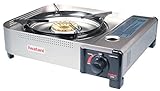
The image above reveals the physical architecture of this system. You can see the conductive plate extending from the burner assembly towards the canister compartment. This simple piece of metal is the difference between a toy and a tool. It transforms the stove from a passive victim of thermodynamics into an active manager of thermal energy.
The Metallurgy of the Burner: Why Brass Matters
If the Heat Panel handles the fuel, the Burner Head handles the fire. In the world of combustion, materials matter. Most budget stoves use stamped aluminum or aluminized steel for the burner head. These materials are cheap and lightweight, but they have low thermal mass and are prone to deformation (warping) under high heat cycles.
The Thermal Stability of Brass
The 35FW employs a Solid Brass Burner. Brass is an alloy of copper and zinc. It is heavier and more expensive than aluminum, but it possesses superior metallurgical properties for combustion.
1. Thermal Capacity: Brass has a higher volumetric heat capacity. It absorbs heat evenly and holds it. This thermal mass helps stabilize the flame temperature, preventing fluctuations caused by minor gusts of wind or changes in fuel flow.
2. Corrosion Resistance: Combustion produces water vapor and trace corrosive acids. Brass is naturally resistant to oxidation and corrosion, ensuring that the tiny gas ports do not clog or degrade over years of use.
3. Dimensional Stability: Unlike aluminum, which softens at relatively low temperatures, brass maintains its structural integrity at the high temperatures of a 15,000 BTU flame. This ensures the gas ports remain perfectly shaped, maintaining the aerodynamic geometry of the flame.
The Aerodynamics of High Output
15,000 BTU (British Thermal Units) is a massive amount of energy for a portable unit. It is roughly equivalent to 4.4 Kilowatts of heat. To burn this much fuel cleanly requires a massive intake of oxygen. The burner head is designed with specific port geometries to induce Venturi Effect, pulling in primary air to mix with the gas before ignition, and shaping the flame to maximize contact with secondary air.
This high-output capability is what allows for techniques like “Wok Hei” (breath of the wok). Wok cooking requires intense, concentrated heat to caramelize sugars and sear proteins instantly. A standard 8,000 BTU stove essentially “steams” the food in its own juices. The 15,000 BTU brass burner of the Iwatani provides the thermal punch necessary to drive off moisture and create the Maillard reaction characteristic of professional Asian cuisine.
The Fluid Dynamics of Wind Resistance
Fire requires three things: Fuel, Oxygen, and Heat. Wind disrupts two of these. It blows away the heat energy, and it disrupts the laminar flow of the gas/air mixture, causing the flame to lift or extinguish.
The Double Windbreaker Architecture
Standard portable stoves use a simple pan support that leaves the flame exposed. The 35FW employs a Double Windbreaker design.
1. The Outer Ring: The chassis of the stove itself rises up to form a wall around the burner. This blocks the direct path of horizontal wind.
2. The Inner Ring: The pan support (grate) has a secondary integrated ring that sits close to the burner head.
This architecture creates a labyrinth for the air. It forces the wind to bypass the flame zone, utilizing the Bernoulli Principle. As wind flows over the top of the stove, it creates a low-pressure zone. Instead of blowing into the flame, the air is pulled over it. This preserves the quiescent (calm) zone around the gas ports where the flame anchors itself.
This fluid dynamic engineering allows the stove to maintain a stable flame in outdoor conditions without the need for cumbersome external folding windscreens. It integrates the protection directly into the functional geometry of the device.
The Safety Engineering: Magnetic Lock vs. Mechanical Lever
In high-energy systems, the interface between the fuel source and the engine is the most critical failure point. Traditional stoves use a mechanical lever to push the canister into the regulator. This relies on the user applying force and mechanical linkages that can bend or jam.
The Magnetic Poka-Yoke
The 35FW uses a Magnetic Locking System. This is a prime example of Poka-Yoke (mistake-proofing), a Japanese manufacturing philosophy.
* Operation: The user simply pushes the canister into the port. A magnet grabs the steel rim of the canister and pulls it into the perfect seating position.
* Safety: If the pressure in the canister rises too high (due to overheating), the force of the expanding gas overcomes the magnetic force. The canister is physically pushed off the regulator, instantly cutting the fuel supply.
This system is “fail-safe.” Unlike a mechanical lever which forces the canister to stay connected even if it’s over-pressurized, the magnetic system uses the dangerous condition itself (high pressure) to trigger the safety mechanism (ejection). It aligns the physics of the failure mode with the physics of the safety solution.
Conclusion: The Cost of Engineering
When we deconstruct the Iwatani 35FW, we see that the price premium is not for the brand name, but for the physics package. You are paying for the Heat Panel that fights thermodynamics to keep your pressure up. You are paying for the Solid Brass that fights metallurgy to keep your flame stable. You are paying for the Magnetic Lock that uses pressure dynamics to keep you safe.
In the world of portable combustion, you can buy a device that simply burns fuel, or you can buy a device that manages energy. The former is a commodity; the latter is an instrument. For the chef who demands the consistency of a commercial range in a portable package, the engineering of the 35FW is the only logical choice. It proves that even in something as simple as boiling water, respect for the laws of physics yields superior results.

