
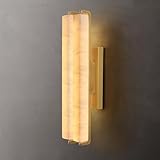
Light, in its rawest form, is directional and harsh. When emitted from a tungsten filament or a modern LED diode, it travels in straight lines, creating sharp shadows and high-contrast boundaries. The history of interior illumination is essentially a history of filtration—humanity’s attempt to tame this raw energy. While glass, fabric, and paper have all served this purpose, few materials possess the complex optical filtering capabilities of Alabaster. The MDEGLYO Alabaster Wall Sconce is not merely a fixture; it is a geological instrument that leverages millions of years of sedimentary pressure to alter the behavior of photons.
To understand why this specific 19-inch prism of stone commands a premium over synthetic alternatives, one must look beyond the aesthetic and into the atomic. The material in question is not the calcite-based marble found in classical sculpture, but a specific variety of gypsum known as Calcium Sulfate Dihydrate (CaSO_4 \cdot 2H_2O). Unlike marble, which is often opaque and reflects light, true alabaster is born from the slow evaporation of ancient saline lakes. This “evaporite” genesis results in a dense, micro-crystalline structure that allows light to penetrate its surface, creating a glow that seems to emanate from the stone’s very core.
The Physics of Subsurface Scattering
The primary optical phenomenon at play in the MDEGLYO fixture is Subsurface Scattering (SSS). In most materials, light interaction is binary: reflection or absorption. When light hits a painted wall, it bounces off. When it hits a black object, it stops. Alabaster functions differently. Because of its translucent crystalline matrix, incoming photons do not immediately reflect off the surface. Instead, they penetrate the outer layer of the stone.
Once inside, these photons enter a chaotic lattice of gypsum crystals. They bounce, refract, and scatter internally, ricocheting thousands of times before finally exiting the material at a different point from where they entered. This “random walk” of photons effectively scrambles the directional information of the light source. The result is a light that has no “hotspot” and no sharp origin. It transforms the single point of an LED bulb into a volumetric field of luminescence. The stone itself becomes the light source. This is why alabaster lighting is often described as “ethereal” or “atmospheric”—it is physically mimicking the diffusion properties of organic tissue or thick wax, materials that we instinctively associate with warmth and life.

Geochemistry: Alabaster vs. Marble
A common nomenclature error in the luxury lighting market is the interchangeable use of “Marble” and “Alabaster.” While MDEGLYO references “Natural Marble” in descriptions to align with consumer search behavior, the material science distinguishes them sharply. Marble is metamorphic rock, primarily calcium carbonate, forged under intense heat and pressure. It is hard (Mohs hardness 3-5), cold, and typically opaque. If you put a light behind a slab of Carrara marble, you might see a faint glow, but it will be blocked by the density of the stone.
The Spanish Alabaster used in these sconces is sedimentary. It has a Mohs hardness of roughly 2, making it soft enough to be carved with exquisite precision but requiring careful handling. This softness is a direct correlate of its translucency. The chemical presence of water molecules within the crystal structure (the “Dihydrate” in Calcium Sulfate Dihydrate) is crucial. These water molecules form part of the lattice that facilitates the transmission of light. The specific “White Snow” texture mentioned in the product specifications indicates a high purity level, lacking the heavy iron oxide contaminants that turn lesser alabaster brown or red. This purity ensures that the light spectrum remains balanced, transmitting the warm kelvin temperatures without muddying the color rendering index (CRI) of the space.
The Marriage of Metal and Mineral
The structural component of the sconce—the brass-finished metal base—serves a role beyond simple support. In bathroom environments, which are a primary application for vertical sconces due to their flattering facial illumination, humidity is a relentless adversary. Alabaster, being porous, can absorb moisture. If mounted directly to a rusting iron bracket, the stone would wick the iron oxide stains into its pores, permanently discoloring the pristine white surface.
The MDEGLYO design utilizes a stainless steel core with a brass finish to create a chemically inert barrier between the mounting hardware and the stone. This prevents galvanic corrosion and protects the stone from internal staining. Furthermore, the elongated 19-inch form factor requires a rigid spine to prevent the stone from fracturing under its own weight. The metal housing acts as an exoskeleton, distributing the torque load across the wall plate rather than stressing the delicate gypsum. This engineering allows the stone to appear to float, suspending a heavy geologic feature with apparent weightlessness.

The Chromatic Impact of Natural Veining
No two pieces of sedimentary rock are identical. This is a manufacturing challenge but a design asset. The “veining” visible in the stone is the fossilized record of mineral impurities present in the ancient water body during the stone’s formation. When illuminated, these veins appear darker, creating a high-contrast map of the stone’s history.
From a lighting design perspective, this natural variation acts as a built-in texture map. Unlike a frosted glass diffuser which produces a flat, uniform white, the alabaster introduces complexity to the light output. It projects subtle, organic patterns onto the adjacent walls. This breaks up the sterility of modern minimalist spaces. It introduces “visual noise” of a biophilic nature, which the human eye finds less fatiguing than the perfect uniformity of synthetic materials. The fixture is not just providing lumens; it is providing information—a visual connection to the chaotic, organic processes of the earth.

