When a cat begins to eliminate outside its designated litter box, it is often perceived by its human companions as a deliberate act of defiance—a behavioral problem. Yet, from a feline behaviorist’s perspective, this is rarely the case. More often than not, it is a desperate communication, a clear signal that the provided environment profoundly conflicts with the cat’s deeply ingrained, ancient instincts. The litter box is not merely a toilet; it is a critical intersection of territory, security, and survival. To design an ideal one, we must first stop thinking like humans and start understanding the world from a cat’s point of view.

The Instinct for Survival: Why Cleanliness Equals Safety
In the wild, a cat is both predator and prey. This duality governs its most fundamental behaviors. The act of burying feces and urine is not about tidiness; it is a critical survival tactic. By masking their scent, wildcats reduce the risk of being tracked by larger predators and avoid alerting potential prey to their presence. This primal drive for a clean, scent-neutral elimination site remains potent in our domestic companions. A soiled litter box, saturated with the smell of ammonia, is not just unpleasant to a cat’s sensitive nose—it is a blaring alarm bell. It signals a location that is “insecure” and “compromised,” a place that, in the wild, would be quickly abandoned. As research in the Journal of Feline Medicine and Surgery has consistently shown, a clean and well-maintained litter box is one of the most significant factors in preventing feline stress and house-soiling issues. This is why automated systems that remove waste immediately after each use are so effective; they don’t just offer convenience for the owner, they continuously reset the environment to a state that the cat’s instincts recognize as “safe.”

A Room with a View: The Need for Space and Situational Awareness
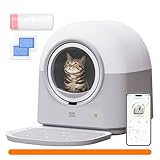
The act of elimination is a moment of profound vulnerability. A cat must feel secure enough to let its guard down. This requires two things: adequate space for its natural ritual and an unobstructed view of its surroundings. The ritual itself is complex: a cat needs room to enter, turn around (sometimes multiple times), dig, posture comfortably, and then cover its waste. A cramped box that restricts this movement can be a significant source of stress. This is why generous internal capacity—such as the 60-liter space found in some modern designs—is more than a luxury; it’s a functional necessity for a cat’s psychological comfort, especially for larger breeds.
Equally important is the sense of an open-concept design. A box with a high entrance or a restrictive hood can make a cat feel cornered and trapped, unable to monitor its environment for potential threats (which, in a domestic setting, could be another pet or even a noisy child). An open-style entrance, even on an enclosed unit, provides the situational awareness a cat needs to feel secure. It allows them to see out while they are inside, fulfilling the instinct to remain vigilant even in a private moment.

The World of Scent: Odor Control as Territorial Integrity
Cats communicate through a complex language of scent, using pheromones to mark their territory and establish social order. A litter box is a key part of this territorial map. When a box is clean, it is a neutral, personal space. When it remains soiled, it becomes a source of confusing and stressful scent signals. The lingering odor of old waste can be interpreted as the presence of an intruder or a sign that this part of their territory is no longer secure.
Advanced odor control is therefore not about masking smells for human benefit; it is about maintaining the territorial integrity for the cat. This is achieved through a combination of strategies. Rapid removal of waste is the first and most effective step. The second is managing the air itself. Ventilation systems and the use of materials with high adsorptive properties, such as activated carbon, work to chemically trap and neutralize airborne odor molecules like ammonia. This ensures the area remains a low-scent, low-stress zone, reinforcing the cat’s sense of ownership and security.
In designing our homes for our feline companions, we must move beyond our own perceptions. The ideal litter box is not an accessory; it is a piece of carefully considered environmental enrichment. By creating a space that honors their primal needs for cleanliness-as-safety, spatial security, and scent neutrality, we are not just solving a “problem.” We are providing a fundamental element of their well-being and showing the deepest respect for the wildcat that still lives within the heart of every domestic cat.