
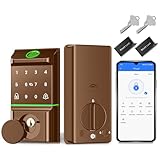
While the hardware of the GGUU 2406A provides the muscle, the software—specifically the TTLock ecosystem—provides the intellect. Many users are baffled by a specific capability of this lock: How can the App generate a time-limited code for a guest when the lock itself is not connected to the internet? The answer lies in Cryptographic Logic, not wireless connectivity (Thesis).
The Magic of Offline Codes: Algorithmic Synchronization
The ability to generate “Time-Limited Passwords” without Wi-Fi is based on a technology similar to the RSA SecurID tokens used in banking or the 2FA apps on your phone. It relies on shared secrets and synchronized time (Physics).
When you initialize the GGUU 2406A with your phone via Bluetooth, the App and the Lock exchange a cryptographic “seed” key and synchronize their internal clocks. From that moment on, both the App and the Lock can independently calculate a valid passcode for any given time slot using a specific algorithm.
* The App says: “Based on our shared secret, the code for next Tuesday at 2 PM is 8834.”
* The Lock thinks: “Based on my internal clock and secret, if someone enters 8834 next Tuesday at 2 PM, I will open.”
This allows landlords to send valid entry codes to tenants via SMS or WhatsApp from halfway across the world, even if the rental property has no internet connection or power outage. It is a brilliant application of deterministic mathematics to solve a connectivity problem (Expert Nuance).

Virtual Password Technology: Anti-Peeping Logic
Another software-driven security feature is the Virtual Password (or Anti-Peeping) function. Humans are notoriously bad at remembering random numbers, but good at remembering patterns. However, fixed PIN codes suffer from “smudge attacks”—grease trails on the screen revealing the frequently used digits—or “shoulder surfing” by bystanders.
The GGUU firmware allows users to input random digits before and after the real password. For example, if your code is 123456, you can type 98231234560019. The lock’s processor buffers the input string and constantly scans for the correct sequence buried within the noise. This exponentially increases the entropy of the input, making it mathematically impossible for an observer to deduce the real code solely by watching your finger movements or examining fingerprints on the panel (Logic).
The Landlord’s Dashboard: Access Hierarchies
The TTLock App transforms the GGUU 2406A from a simple deadbolt into an Access Control System. It supports a hierarchical user structure:
1. Administrator: Has full control, can change settings, and view audit logs.
2. Authorized Admin: Can manage sub-users but cannot factory reset the lock.
3. User (Fingerprint/Card/Code): Can only unlock.
For Airbnb hosts or office managers, the Audit Log (Real-time information notification) is invaluable. Every successful entry is timestamped and logged. If the lock is connected via the G2 Gateway (Wi-Fi), these logs are pushed to the cloud instantly. If using Bluetooth only, the logs are stored locally on the lock’s memory and synced to the Admin’s phone the next time they connect. This “store-and-forward” mechanism ensures data integrity even during network downtimes (Scenario).

Auto-Lock Logic: The Safety Net
The “Automatic locking function” is a simple timer-based logic script running on the lock’s microcontroller. Users can set a delay (e.g., 5 to 60 seconds). While convenient, relying on a timer has a flaw: the lock doesn’t know if the door is actually closed. It will extend the deadbolt regardless. If the door is ajar, the bolt will slam against the frame, potentially damaging the mechanism. Advanced users should pair this feature with a separate door sensor or ensure the door closer mechanism is robust enough to fully latch the door before the timer expires (FMEA).
Conclusion: Software as the Force Multiplier
The GGUU 2406A’s hardware is adequate, but its software architecture is advanced. By leveraging the mature TTLock platform, it offers enterprise-grade access management features—like offline code generation and hierarchical permissions—at a consumer price point. It proves that smart security is as much about the code running on the chip as the metal protecting it.

