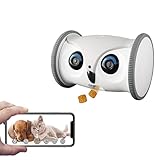
It is a moment of trivial, almost comical failure. A sleek, two-wheeled robot, such as the SKYMEE Owl, confidently glides across a polished hardwood floor. It approaches the edge of a medium-pile area rug, a transition a toddler could navigate with ease. Its wheels make contact, tilt, and then spin uselessly. The robot is stuck. This small defeat, repeated in thousands of homes with thousands of different devices, is a microcosm of one of the most significant and underestimated challenges in consumer robotics. For a mobile robot, the average family home is a treacherous obstacle course, and in this world, the rug is often lava. The promise of an autonomous companion that can find and follow a pet anywhere in the house collides with this simple, frustrating reality.

The core of the problem lies in a fundamental mismatch: our homes are, in engineering terms, “unstructured environments.” They are not the flat, predictable factory floors where industrial robots thrive. They are a chaotic landscape of varying floor textures, unexpected clutter, tight corners, and changing layouts. For a robot to succeed in this space, it must master two fundamental skills that humans take for granted. First, it must have the physical ability to traverse the terrain. This is the challenge of mobility. Second, it must know where it is and where it is going. This is the challenge of perception and localization. The failure of many consumer robots can be traced back to a critical underestimation of one or both of these pillars.
The challenge of mobility is a question of pure physics. The SKYMEE robot’s two-wheel, self-balancing design is a classic example of prioritizing agility over stability. While it allows for elegant, zero-radius turns, it creates a high center of gravity and requires constant, precise adjustments to maintain balance. This makes it exquisitely sensitive to surface imperfections and inclines, like the edge of a rug. The small wheels lack the torque and clearance to overcome the obstacle, leading to the “stuck” scenario. Contrast this with the design of most successful robot vacuums, which typically employ a four-wheel or three-wheel differential drive system. Their large, often spring-loaded wheels provide a more stable base and a better mechanical advantage for climbing over small obstacles like room thresholds and, critically, area rugs. They trade the aesthetic elegance of a balancing act for the brute-force reliability needed for the real world.
But raw physical prowess is not enough. A robot that can cross any obstacle but has no idea where it is, or where it’s going, is merely a powerful brute. To be truly useful, it must also solve the second, more complex challenge: it needs a brain and a map. This is the world of perception and localization. The simplest and cheapest systems, often found in robot toys, rely on basic bump sensors and infrared cliffs detectors. These robots are effectively blind; they operate on a simple algorithm of “move forward until you hit something, then turn.” They build no memory or map of the environment, making jejich movement inefficient and repetitive.
A significant step up from this is Visual SLAM, or vSLAM (Simultaneous Localization and Mapping). This technology, utilized by many mid-tier robot vacuums, employs a camera pointed at the ceiling or walls. It identifies unique features—light fixtures, corners, picture frames—and uses them as landmarks to build a rough map of the room and triangulate its own position within it. While ingenious and cost-effective, vSLAM has its weaknesses. According to researchers at Carnegie Mellon’s Robotics Institute, its accuracy can be heavily degraded by poor lighting, rooms with sparse features (like a long, white hallway), or even just fast movement that blurs the camera’s vision.

The current gold standard in consumer robotics is LiDAR (Light Detection and Ranging). Imagine a small, spinning turret on top of the robot, shooting out a harmless laser beam thousands of times per second. By measuring the time it takes for the laser to bounce off objects and return, the robot builds an incredibly precise, millimeter-accurate 2D map of its surroundings, regardless of the lighting conditions. This is why high-end robotic vacuums can navigate in perfect darkness and create the detailed floor plans you see in their apps. This superior performance, however, comes at a steep cost; the LiDAR sensor assembly alone can cost more than an entire low-end vSLAM robot.
This hierarchy of technology explains the vast price and performance differences in the home robot market. The failure of a device like the SKYMEE Owl is not a fluke; it is the predictable outcome of pairing an ambitious goal (all-home pet tracking) with a rudimentary mobility and perception system. It serves as a vital lesson for consumers: the true value of a mobile robot lies not in its app-based features, but in its foundational ability to navigate your unique home. Before being swayed by a 1080p camera or a treat dispenser, ask the most important question: can it handle the rug?

