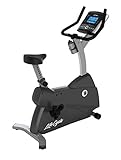
Consider two parallel scenes. In one, a rider is on a sleek, modern bike, its massive HD screen transporting them to a virtual Tuscan hillside. A charismatic instructor shouts encouragement, a live leaderboard scrolls relentlessly, and social notifications pop up celebrating a friend’s milestone. The experience is a dazzling symphony of digital stimuli. In the second scene, a rider sits on a Life Fitness C1 bike. Its console is a simple blue LCD screen. There is no scenery, no instructor, no leaderboard. The only data points are time, RPM, and heart rate. The only soundtrack is the rider’s own breath. The first scene is engaging, entertaining, and undeniably “smart.” The second is simple, focused, and, by modern standards, “dumb.” The prevailing wisdom of the fitness industry tells us the first experience is superior. But is it?

We live under the tyranny of connection, an era where the value of a device is often measured by the richness of its feature set and the seamlessness of its integration into our digital lives. This has led to a phenomenon known as “feature creep” or “functional overload.” As market research from firms like Gartner consistently shows, consumers are increasingly feeling a sense of fatigue from devices that demand constant interaction and decision-making. Before the “smart” workout even begins, one must choose a class, a trainer, a music genre, and a difficulty level. This cascade of choices, however trivial, can contribute to decision fatigue, subtly depleting the very willpower needed for the workout itself. This constant barrage of digital stimuli creates a workout experience that is undeniably engaging. But is it effective at building a sustainable, internal drive? To answer that, we must turn from user interface design to the fundamental psychology of what makes an activity truly rewarding.
Enter the concept of “Flow,” a term coined by psychologist Mihaly Csikszentmihalyi to describe a state of optimal experience where one is so completely absorbed in an activity that everything else seems to disappear. According to Csikszentmihalyi’s research, achieving a flow state has several prerequisites: a clear goal, immediate feedback, and a balance between the challenge of the task and the skill of the performer. Crucially, it requires intense concentration on the present moment. The endless notifications, social pressures, and entertainment layers of many connected fitness platforms are, by their very nature, antithetical to this deep, undistracted immersion. They are designed to pull your attention outward, not inward. A simple console, with its clear goal (maintain a certain heart rate or cadence) and immediate feedback (the numbers on the screen), creates a perfect, uncluttered environment for flow to emerge. It transforms the workout from a media consumption experience into a meditative practice.
This distinction leads to the core engine of any long-term habit: motivation. According to Self-Determination Theory, one of the most robust theories in modern psychology, motivation exists on a spectrum from extrinsic (driven by external rewards like praise, trophies, or avoiding punishment) to intrinsic (driven by the inherent enjoyment and satisfaction of the activity itself). Connected fitness platforms are masters of extrinsic motivation. They leverage gamification, social validation, and leaderboards to keep you coming back. While effective in the short term, studies in journals like Computers in Human Behavior have warned of the “overjustification effect,” where an over-reliance on external rewards can actually erode a person’s intrinsic motivation for the activity. The workout becomes a means to an end (climbing the leaderboard) rather than an end in itself.

If the long-term goal is to cultivate a love for the activity itself, an over-reliance on external rewards can be a dangerous game. This brings us to the stark, almost monastic simplicity of a console like the Go Console on the Life Fitness C1. At first glance, it seems archaic. But viewed through the lens of motivational psychology, its deliberate limitations begin to look like a radical and insightful design statement. The absence of a screen is not a flaw; it is the gift of focus. The lack of an integrated app is not a limitation; it is freedom from digital noise. The console’s most advanced feature—its ability to accurately track heart rate via a wireless strap—reveals its true purpose. It is not designed to entertain you; it is designed to allow you to train. It provides the essential data needed for a serious, goal-oriented session, and then it gets out of the way. It is a tool, not a television.
Ultimately, the choice between a “smart” and “dumb” console is not a technological one, but a philosophical one. It requires asking yourself a fundamental question: What kind of athlete do I want to be? Are you someone who needs external entertainment and social accountability to overcome the friction of starting a workout? If so, the connected experience may be a powerful ally. Or are you someone who seeks a space for focus, a sanctuary of sweat where you can connect with your own body and breath, free from the demands of the digital world? If that is your goal, then the humble, “dumb” console might just be the most intelligent choice you can make. It offers not a distraction from the work, but a deeper immersion into it.

