
The allure of espresso is often shrouded in a romantic mystique—the Italian café, the skilled barista, the hiss of a steam wand. But beneath this artistry lies a foundation of hard science. A great shot of espresso is not a happy accident; it is a repeatable experiment in fluid dynamics and organic chemistry, conducted in the miniature laboratory of your kitchen counter. To master espresso is to trade alchemy for architecture, to understand the fundamental forces at play and use them to construct your perfect cup, time and time again.
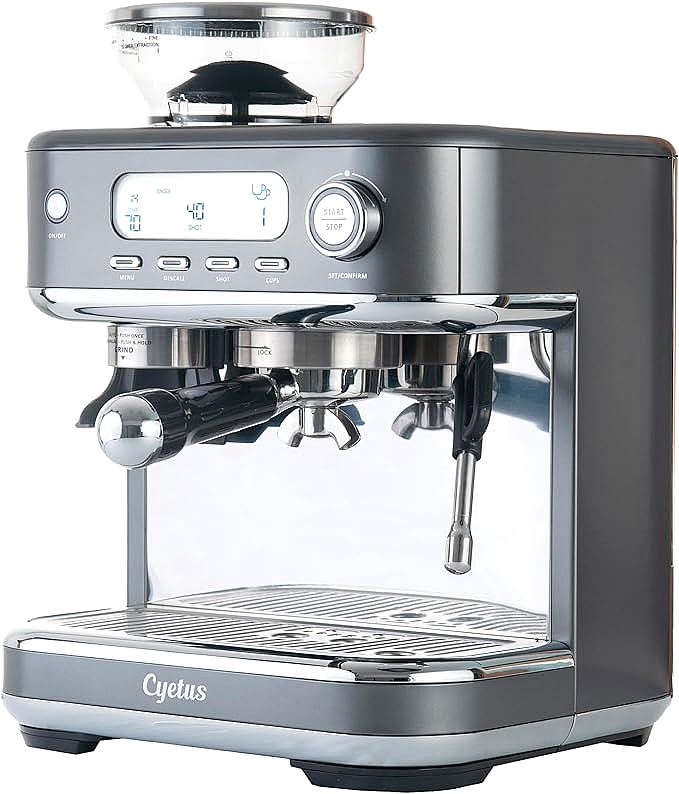
This guide is not about which button to press. It is about why you press it. We will dissect the three pillars of extraction—grind, pressure, and temperature—using the features of a modern all-in-one machine not as a product, but as our scientific instrument for controlling these powerful variables.

Act I: The Geometry of Flavor – Why Grind Is King
Before water ever touches coffee, the most critical decision has already been made: the grind. The transformation of a hard, inert bean into a uniform powder is an exercise in manipulating surface area, and in espresso, surface area dictates everything that follows.
Imagine trying to dissolve a sugar cube versus a spoonful of granular sugar in water. The granular sugar dissolves faster because the water can attack it from countless more angles. Coffee is no different. A conical burr grinder, unlike a chaotic blade grinder that merely shatters beans into a random assortment of dust and boulders, uses a precise milling action to produce a far more consistent particle size. This consistency is the bedrock of a good extraction. With a range of settings, from coarse to fine, such a grinder allows for exacting control over the total available surface area of the coffee grounds.
This surface area creates hydraulic resistance. When you tamp the coffee into a puck, you are creating a porous filter. The finer the grind, the smaller the gaps between particles, and the harder it is for water to pass through. This resistance is what allows the machine’s pump to build pressure. If the grind is too coarse (like sand), water gushes through in a process called under-extraction, resulting in a sour, weak shot. If it’s too fine (like flour), the water can’t penetrate at all, or it carves channels through the puck, leading to a bitter, over-extracted taste. The goal is to find the “sweet spot” where the grind provides just enough resistance to allow for an ideal extraction time, typically in the 25-30 second range for a standard shot. Dialing in your grinder is not just a morning ritual; it’s the primary calibration of your entire experiment.
Act II: The Hydraulic Heartbeat – The Force of Extraction
With our coffee grounds now prepared to a near-molecular specification, we turn to the force that will transform this inert powder into liquid gold: pressure. The heart of any espresso machine is its pump. While many pumps are rated for 15 bars or more, the industry standard for actual extraction, established through decades of sensory science, is approximately 9 bars of pressure at the group head. That’s nine times the atmospheric pressure at sea level being forced through your coffee.
What does this intense pressure achieve? It does two things. First, it physically forces water to permeate the tightly compacted coffee puck, ensuring an even and rapid saturation that wouldn’t be possible with gravity alone. Second, and more magically, it emulsifies the natural oils within the coffee beans with the CO2 gas (a byproduct of roasting) and soluble solids. This beautiful, volatile emulsion is what we call crema—the reddish-brown, micro-bubbled layer that crowns a well-pulled shot. Crema is not just foam; it’s a significant contributor to the aroma, mouthfeel, and lingering aftertaste of the espresso.
Many modern machines also employ a pre-infusion stage. Before applying the full 9 bars, the machine introduces water at a low pressure for a few seconds. This gentle wetting allows the dry coffee puck to swell and settle, closing any potential cracks or fissures. This simple step dramatically reduces the risk of “channeling,” where water finds a path of least resistance and bypasses most of the coffee bed, leading to a disastrously uneven extraction. It’s the pump’s thoughtful pause before the powerful, steady heartbeat that extracts the very soul of the coffee.

Act III: The Thermal Soul – A Delicate Dance with Temperature
Pressure alone is a blunt instrument. It can force water through the coffee, but what that water extracts is a delicate negotiation governed by our final and most nuanced variable: temperature. Coffee chemistry is incredibly sensitive to heat. Different flavor compounds dissolve at different rates and at different temperatures.
A simple thermostat-controlled machine might have a wide temperature swing, heating up and cooling down by several degrees. This is the enemy of consistency. A Proportional-Integral-Derivative (PID) controller, by contrast, is like a cruise control system for temperature. It constantly monitors the heating element and makes rapid, minute adjustments to hold the water temperature incredibly stable, right at the target.
This stability is crucial because temperature is how we target specific flavors. An adjustable machine might offer low, medium, and high settings. These settings allow a user to fine-tune the brewing water to land within the Specialty Coffee Association’s recommended extraction range of 90-96°C (195-205°F), tailoring the heat to the specific bean being used.
The Flavor Extraction Curve
Think of extraction as a journey through flavors over time, heavily influenced by temperature:
(Conceptual Infographic: A line graph showing extraction time on the X-axis and perceived flavor on the Y-axis. The curve begins in a “Sour (Acids)” zone at the start of the shot, rises to a “Sweet (Sugars & Oils)” peak in the middle, and then descends into a “Bitter (Tannins & Dry Distillates)” zone towards the end.)
- Too Cool (Under-Extraction): Water below 90°C is less efficient at dissolving solids. It will primarily extract the faster-dissolving acidic compounds, resulting in a sharp, sour shot that lacks sweetness and body.
- Too Hot (Over-Extraction): Water above 96°C extracts everything too quickly, including the less desirable bitter and astringent compounds from the coffee’s woody structure. This scalds the grounds, masking delicate nuances with a harsh, burnt flavor.
- The “Sweet Spot”: The ideal temperature range is a balancing act. It’s hot enough to dissolve the desirable sugars and oils that create sweetness and body, but not so hot that it extracts an overwhelming amount of bitterness. The ability to adjust your machine’s temperature setting allows you to steer the extraction. A slightly cooler temperature might highlight the bright, fruity acidity of a light-roast Ethiopian bean, while a slightly hotter temperature could draw out the deep, chocolatey notes of a dark-roast Sumatran.
Conclusion: From Alchemist to Architect
Understanding the science of espresso demystifies the process. It transforms you from an alchemist, mixing potions and hoping for magic, into an architect, designing a beverage with intention and precision. The grinder controls the foundation, pressure provides the structure, and temperature finishes the fine details. Every cup becomes a data point, a learning opportunity. The goal is no longer just a single great shot of coffee, but the knowledge and confidence to create one whenever you desire. That, in itself, is the most satisfying result of any experiment.