
For many, the drip coffee maker is a black box. We add grounds and water, press a button, and coffee appears. When it tastes flat, sour, or disappointingly bitter, we might blame the beans or the grind. But what if the real culprit lies hidden within the machine itself—in the unseen worlds of thermodynamics, fluid dynamics, and extraction chemistry? The journey from a mediocre cup to a sublime one is not a matter of luck; it is a triumph of engineering over chaos. A modern, well-designed brewer is not merely an appliance; it is a precision instrument, meticulously engineered to solve the fundamental physics problems that have plagued coffee lovers for over a century.
To understand your coffee, you must first understand the scientific challenges it presents. Let’s deconstruct the process, moving beyond the ‘start’ button to appreciate the silent, intricate ballet of science happening inside.

The Tyranny of Temperature: Why 96°C is the Magic Number
The single most important variable in coffee brewing is temperature. Coffee extraction is a complex chemical reaction where hot water acts as a solvent, pulling hundreds of aromatic compounds out of the roasted beans. These compounds—acids, sugars, oils, and melanoidins—dissolve at different rates. The Specialty Coffee Association (SCA) has established the “Gold Cup” standard, recommending a water temperature between 195°F and 205°F (90°C to 96°C) for optimal extraction.
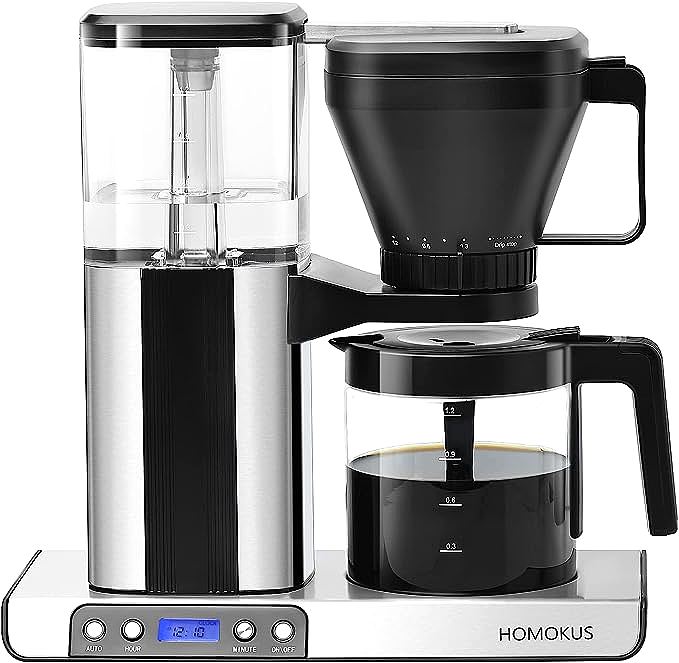
Why this specific window? Below 195°F, the water lacks the energy to efficiently dissolve the desirable sugars and oils, resulting in a thin, sour, and underdeveloped cup—a phenomenon known as under-extraction. Conversely, pushing the temperature above 205°F aggressively dissolves bitter, astringent compounds, leading to a harsh, over-extracted brew. The challenge for any coffee maker is to not only reach this ideal range but to maintain it consistently throughout the entire 4-to-6-minute brew cycle. This requires significant thermal power. A low-wattage machine might start hot but will suffer a temperature drop as cooler water enters the heating system, starving the later stages of the brew of thermal energy. This is where a powerful heating element, often rated at 1400 watts or higher, becomes critical. In models such as the HOMOKUS NK-0655, a 1475-watt unit ensures the water is rapidly heated to the target temperature and held there, providing the thermal stability necessary for a balanced and complete chemical extraction from the first drop to the last.
The War on Channeling: The Hydrodynamics of a Shower Head
But even with perfectly heated water, disaster can strike. If that water isn’t delivered correctly, it creates invisible channels of failure in your coffee bed. This brings us from the realm of chemistry to the world of physics: the hydrodynamics of extraction. Imagine pouring water from a single spout onto a bed of dry grounds. The water will drill a path of least resistance, a phenomenon called “channeling.” Grounds along this channel will be pummeled with water, becoming severely over-extracted and bitter. Meanwhile, grounds just centimeters away may remain almost dry, their flavors locked away, contributing only sourness. The resulting cup is a muddled mess of both extremes.
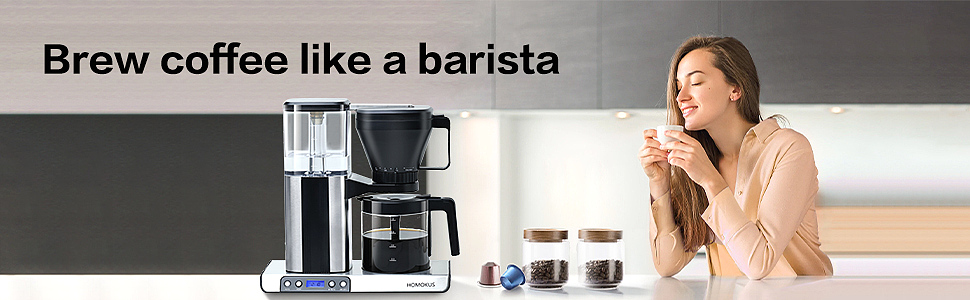
The engineering solution is a multi-hole shower head. Instead of a single, aggressive stream, a well-designed head with 5 to 9 dispersion holes acts like a gentle rainfall. This design serves two crucial functions. First, it allows for a “bloom”—the initial wetting of the grounds that releases trapped CO2 from the roasting process. This degassing prevents the gas from repelling water and ensures the entire coffee bed is receptive to extraction. Second, it promotes uniform saturation. By distributing the water evenly across the entire surface area of the coffee, it ensures that every single particle contributes its fair share to the final flavor profile. This meticulous control over water delivery is a direct replication of the careful, spiraling pour of a professional barista, automated for perfect consistency. It’s a purely physical solution to a devastating flavor problem.
The Art of Contact Time: Controlling Strength and Flavor
Achieving uniform saturation is a major victory, but the battle isn’t over. The next critical variable we must command is time. For how long should this perfectly heated, evenly distributed water interact with the grounds? The answer, known as contact time, determines the very soul of the coffee: its strength. Strength, scientifically measured as Total Dissolved Solids (TDS), is simply the percentage of coffee solids dissolved into the final brew. The SCA Gold Cup standard targets a TDS of 1.15% to 1.45%.
Longer contact time allows the water to dissolve more solids, resulting in a stronger, richer cup. Shorter contact time yields a lighter, more delicate brew. Most basic coffee makers offer no control over this; they have a fixed flow rate. This is a one-size-fits-all approach that fails to account for different beans, roast levels, or grind sizes. A dark, porous roast may require less time to avoid bitterness, while a dense, light roast from Ethiopia might need more time to unveil its complex floral notes. Advanced brewers solve this by introducing a user-controlled flow-rate valve. A mechanism like the switch valve found on some modern machines empowers the user to directly manipulate contact time. By selecting a slower drip, you extend the steeping duration, pushing towards a higher extraction and a bolder cup. It transforms the machine from a static appliance into a dynamic brewing instrument, allowing you to dial in the perfect recipe for any coffee.
The Engineered Solution: A System in Harmony
These three pillars—temperature, water distribution, and time—do not work in isolation. They form an interconnected system where each element must be precisely controlled to achieve the desired outcome. The ideal brew, with a final extraction yield between 18% and 22% of the coffee’s mass, is a delicate balance.
This chart illustrates how these scientific variables map directly to modern engineering solutions:
| Scientific Variable | The Challenge | The Engineering Solution | Impact on Flavor |
|---|---|---|---|
| Temperature | Inconsistent heat leads to under- or over-extraction. | High-wattage heating element (e.g., >1400W) for thermal stability within the 195-205°F range. | Balances sweetness, acidity, and bitterness. |
| Uniformity (Flow) | “Channeling” causes uneven extraction, mixing sour and bitter notes. | Multi-hole shower head (e.g., 9-hole design) for even saturation and proper blooming. | Creates a clean, clear, and balanced flavor profile without defects. |
| Contact Time | Fixed brew duration doesn’t suit all coffees, leading to weak or overly strong results. | Adjustable flow-rate valve to control the water’s residence time with the grounds. | Allows user to dial in desired strength (TDS) and richness. |
Conclusion: From Black Box to Brewing Instrument
The next time you brew a cup of coffee, look beyond the simple interface. See the powerful heater fighting against entropy to maintain a perfect thermal state. See the shower head orchestrating a complex dance of fluid dynamics to ensure every ground is treated with equity. See the flow valve as a conductor’s baton, dictating the tempo of extraction. A great coffee maker is the embodiment of over a century of scientific understanding, a device that has tamed thermal chaos and mastered the physics of flow.
However, this precision instrument works best in skilled hands. While the machine provides the tools for consistency, the user remains a crucial partner in the process—by selecting a quality grind, distributing the grounds evenly, and using the available controls wisely. By understanding these unseen principles, you transform yourself from a passive user into an active participant, capable of wielding this remarkable instrument to consistently create the perfect cup.